




For decades, internet users were trained to talk like search engines. We compressed complex, real-world problems into rigid keyword fragments: “flat feet running shoes,” “portable AC under $300,” or “italy 7 day itinerary.” We did the heavy lifting ourselves—parsing pages of blue links and manually piecing together an answer.
That dynamic has flipped.
According to Google’s data on AI Mode—which now commands over 1 billion monthly active users and has seen query volumes more than double every quarter—consumers are no longer adapting their language to match algorithms. Instead, they are handing their full context, constraints, and messy logic directly over to AI.
Search is no longer just an information discovery tool; it has transformed into a decision and action gateway. Here is how consumer behavior is shifting—and what it means for brands, publishers, and merchants trying to stay visible.
1. From Keywords to Full Context: Queries Triple in Length
▲ Source: News from Google
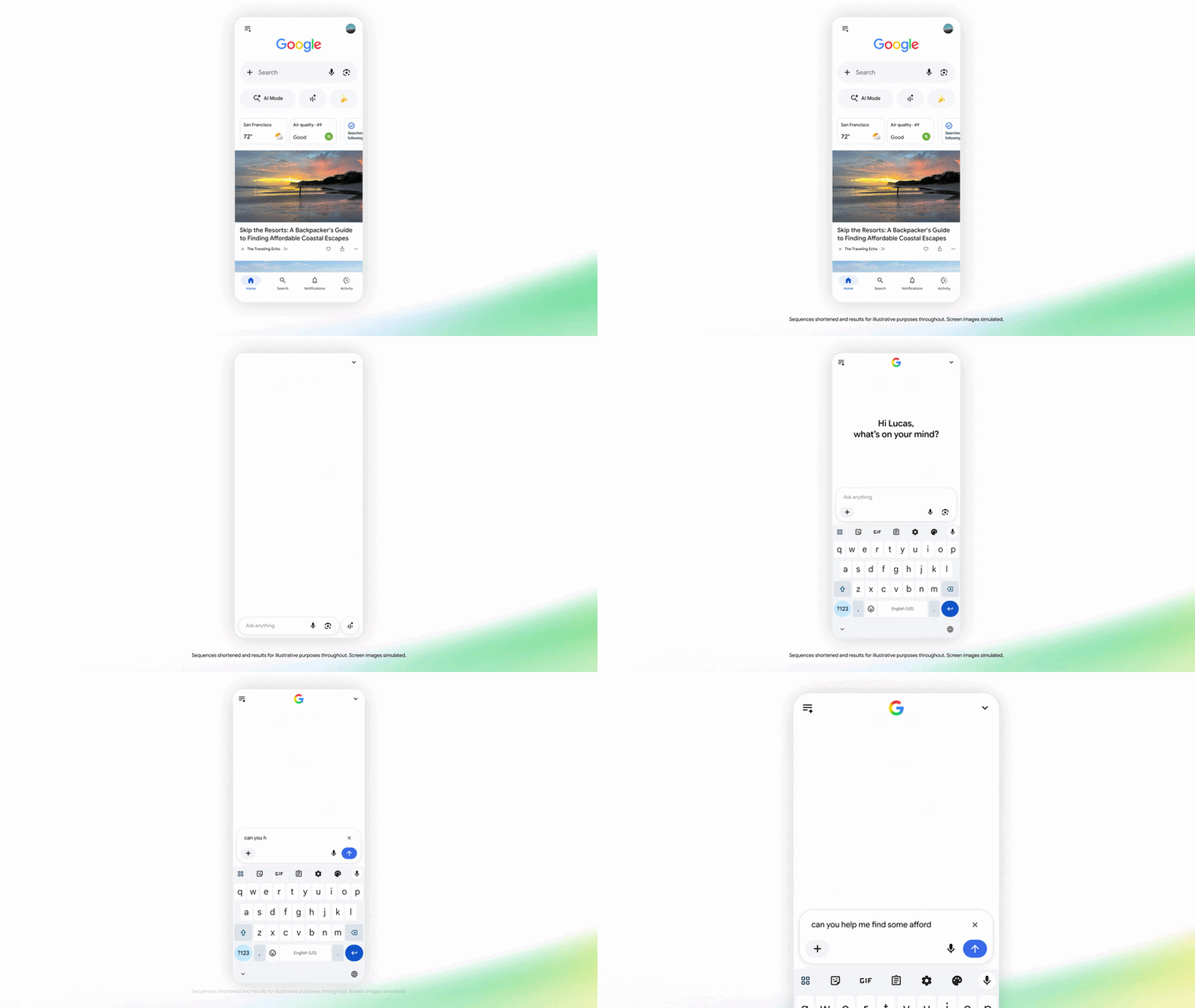
The most immediate shift in consumer behavior is verbosity. Searchers are no longer asking, “What keywords will get me the right result?” Instead, they ask, “What is my actual problem, and what context does the AI need to solve it?”
The average query in AI Mode is now three times longer than traditional search inputs.
Traditional Keyword Search:
“portable AC under $300”
AI Mode Contextual Prompt:
“I live on the third floor of an old brick building with no central air, my bedroom is 200 sq ft, and my cat sleeps by the window. I have a $300 budget, need something quiet at night, and don’t want my electric bill to skyrocket. What are my best options?”
When users share their budget, spatial constraints, and personal circumstances upfront, search transforms from a single-keyword query into an ongoing dialogue. Follow-up refinements within AI Mode are growing at over 40% month-over-month.
What This Means for Brands:
- Move Beyond Broad PR & Generic Keywords: High-volume, short-tail keywords are losing their monopoly.
- Answer Long-Tail Scenario Questions: Product pages and content strategies must explicitly define who the product is for, when it should be used, and what limits it has. If your content doesn’t address specific constraints, AI engines won’t synthesize your product into the answer.
2. From Text Inputs to Real-World Capture: Multimodal Search

▲ Source: News from Google
Some problems are notoriously difficult to put into words. Rather than hunting for vocabulary to describe an issue, consumers are increasingly snapping a photo or using voice.
Today, more than 1 in 6 AI Mode queries (over 16%) are non-text. The adoption metrics reflect a rapid shift toward visual search:
- Non-Text Search Share: Now represents over 16% of all AI Mode queries.
- Image Input Growth: Increasing at over 40% month-over-month.
- Generative Image Creation: Requests for image generation and photo edits have tripled (over 300% growth) since the start of the year.
Consumers are pointing their cameras at real-life scenarios—a strange plant in the yard, a hairline crack in a wall, an outfit seen on the street, or an empty corner in a living room—and progressing seamlessly from “What is this?” to “Why is this happening?” to “Where can I buy a solution?”
What This Means for Brands:
- High-Context Visual Assets: Plain white-background product shots are no longer enough. Brands need high-resolution, multi-angle images showing products in real-world environments so vision models (like Google Lens) can accurately recognize and match them.
- Granular Visual SEO: Image metadata and alt text must be richly descriptive, detailing exact styles, colors, materials, patterns, and model numbers.
3. From Finding Answers to Making Decisions: “Do” and “Decide” Take Over
▲ Source: News from Google
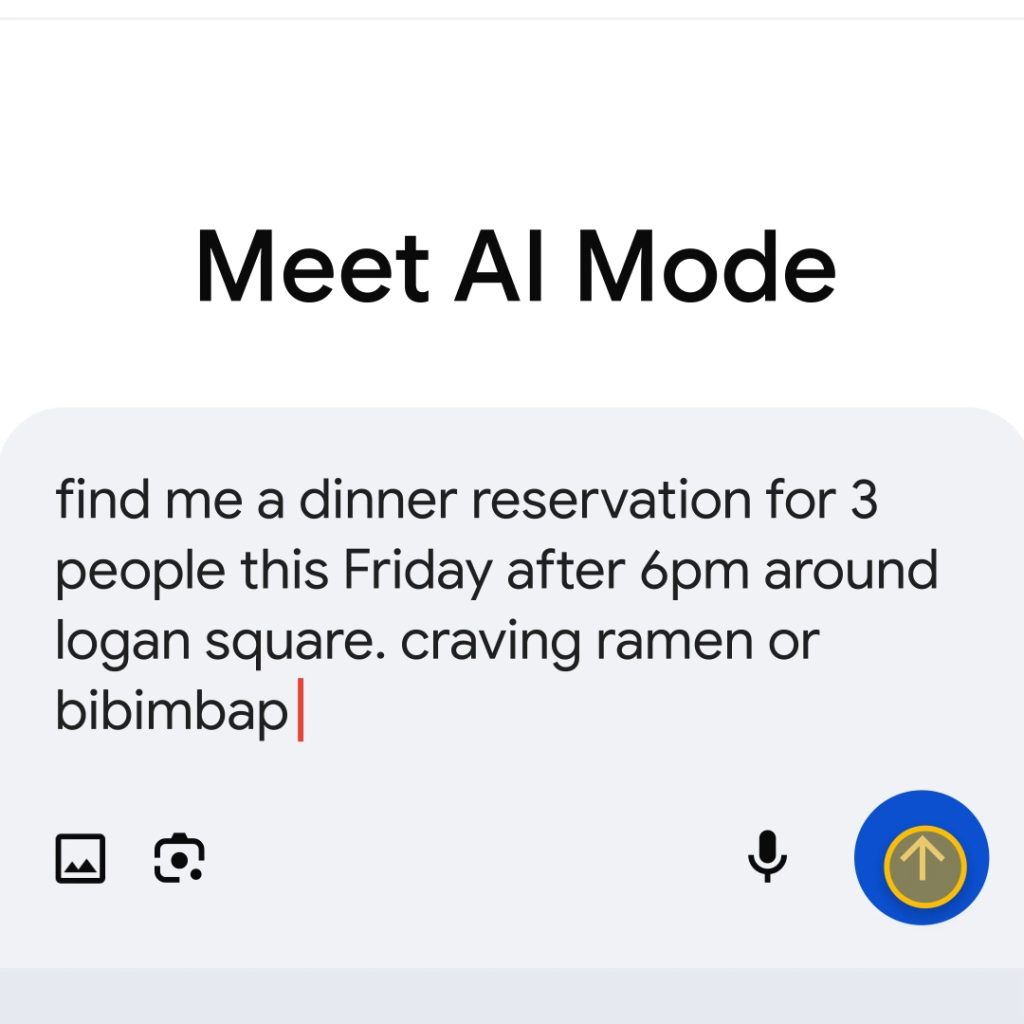
Google categorizes AI search behaviors into five core modes: Explore, Decide, Learn, Create, and Do. The sharpest growth is happening in execution and evaluation:
- Planning & Execution (Do): Growing 80% faster than overall AI Mode queries. Focuses on complex logistics, custom travel itineraries, budget trackers, and exercise splits.
- Decision & Comparison (Decide): Growing 40% faster for queries starting with “Which” (specifically “Which of” and “Which one”).
Instead of searching “best running shoes” and reading through five affiliate blog posts, consumers ask targeted comparison questions:
“Which running shoe is better for someone with flat feet who runs 30 miles a week and wants to stay under $150?”
Consumers aren’t just asking what exists—they are asking which option fits them best. When evaluating local businesses, users heavily rely on follow-up prompts to filter by specific attributes, such as family-friendly, outdoor seating, in-stock status, or replacement parts availability.
What This Means for Brands:
- Anticipate “Step 2” Questions: Map out the exact follow-up questions customers ask during their decision process (e.g., maintenance costs, warranty terms, return policies, compatibility) and address them transparently on your site.
- Complete Business Attribute Data: Ensure your Google Business Profile and structured web schema are fully populated with granular attributes (e.g., parking, accessibility, real-time inventory, dietary options). Missing data means being filtered out of AI shortlists.
4. The New Brand Mindset: Becoming an Authoritative Data Source
Search hasn’t disappeared—it has evolved from a directory into an intelligent intermediary. The initial touchpoint between a customer and a brand is shifting away from the traditional Search Engine Results Page (SERP). Instead, consumers are asking the AI:
- “Which brand should I trust for this specific use case?”
- “Is this product actually right for my room size and budget?”
- “If I have $500, which setup gives me the best value?”
For businesses, the central strategic question has changed. It is no longer: “How do I rank #1 for this keyword?”
It is now: “Does the AI understand my brand, cite my content, and include my product in the user’s shortlist?”
To win in the era of AI search, brands must stop focusing solely on selling and focus on becoming an authoritative, machine-readable data source. By structuring real-world information, clarifying product limits, and providing transparent answers to complex questions, brands ensure that when AI synthesizes a solution, their product is chosen as the answer.