



“Can you find me a folding e-bike I can carry up two flights of stairs?”
That shopper has already told you more than a search for “best e-bike” ever could. They’ve told you where they live, what they’ll do with the bike every day, and which specification might make or break the sale. If your best product photo shows a bike tearing down a mountain trail, you might be telling the wrong story.
That’s what makes ChatGPT Ads interesting for Shopify brands. An ad can appear while someone is working through a purchase decision. The job of the ad is to give them a relevant option. The job of your store is to give them enough information to decide.
The shopping starts before the click
In Shopify’s 2026 Global Holiday Retail Report, 65% of shoppers said they planned to use AI for at least one holiday shopping task. The survey covered 18,000 adults across nine markets. It measured what people said they intended to do. Shopify’s holiday research · Survey methodology
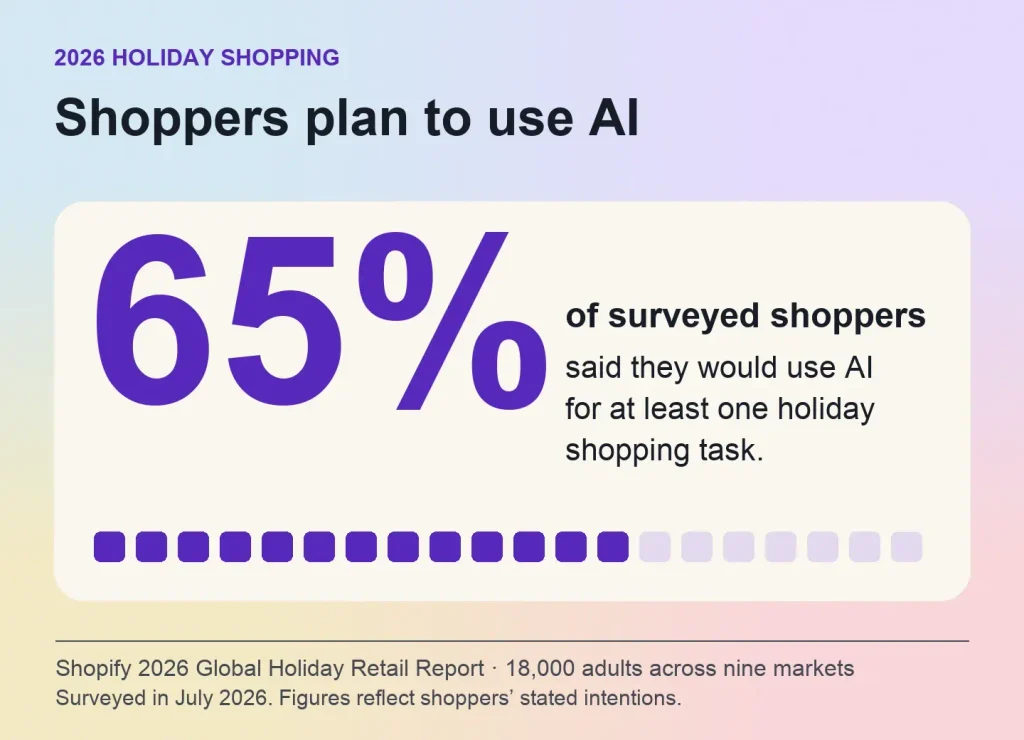
▲ Shopify’s holiday survey measured stated intent.
Adobe forecasts 130% year-over-year growth in AI referrals to U.S. retail sites this holiday season. In September 2026, it also observed a 90% higher conversion rate and 83% higher revenue per visit for AI-referred traffic than for other traffic. Those figures describe referrals from AI services broadly. Use them to understand how shoppers are arriving, then measure paid ChatGPT Ads against your own store’s economics. Adobe’s holiday forecast · Adobe’s September retail analysis
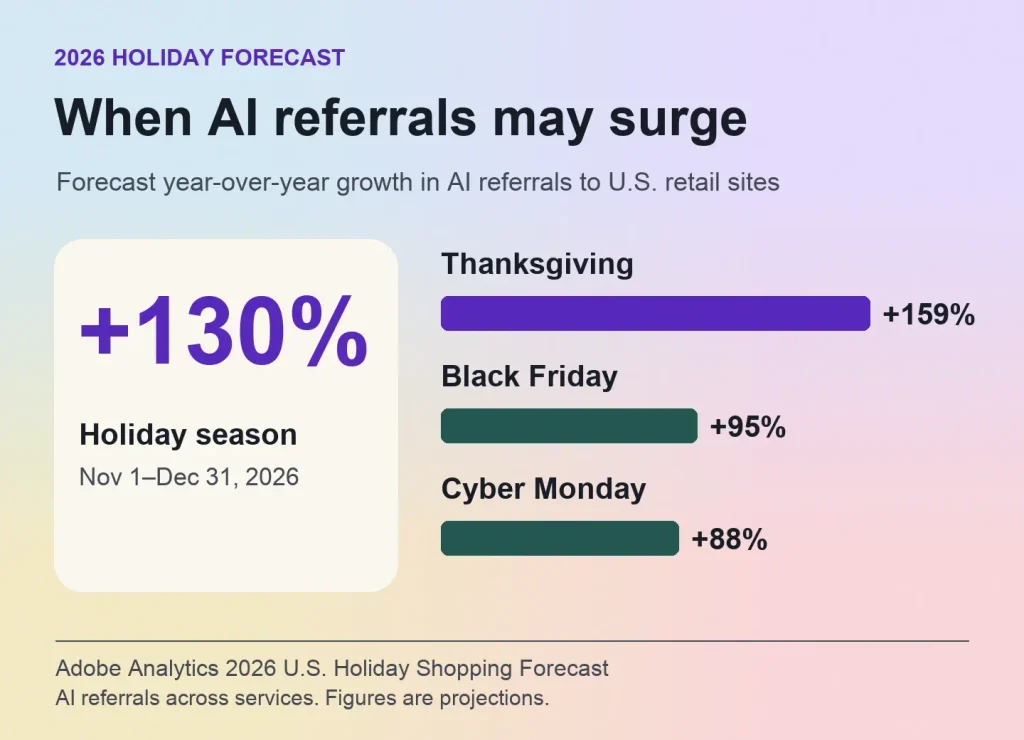
▲ Adobe’s holiday forecast covers AI referrals across services.
AI referral results and ChatGPT product searches
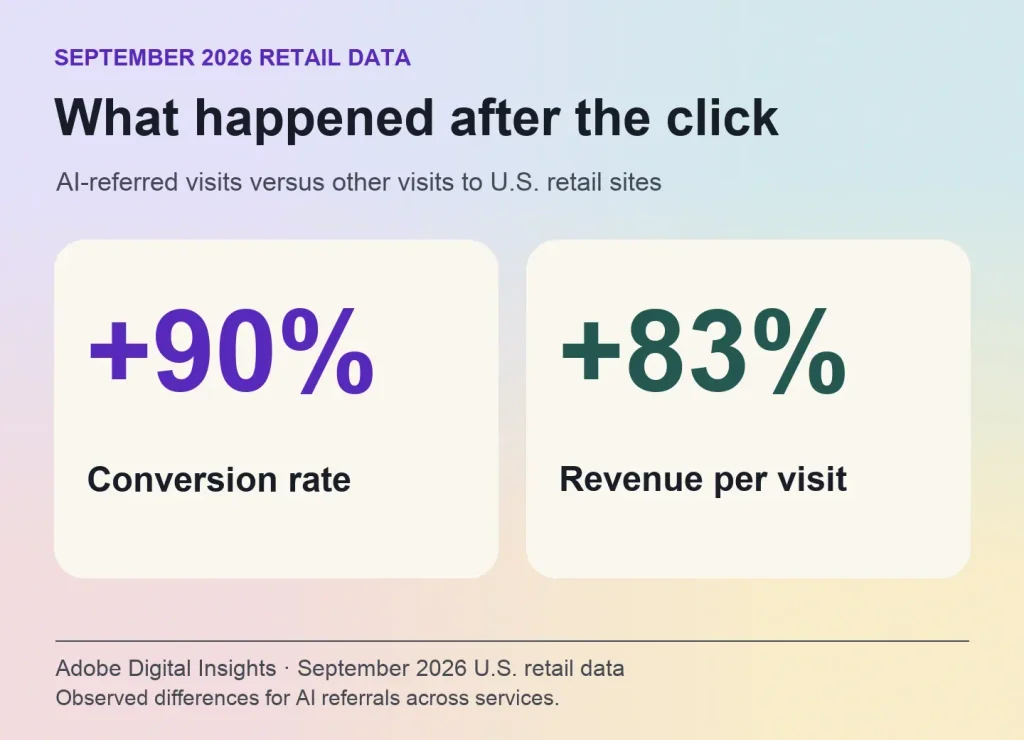
▲ Observed AI referral data across services from Adobe Digital Insights.
The holiday blueprint offers a more specific timing clue. Average daily ChatGPT product-search activity rose 53% in France, 43% in Italy and 39% in the UK in November and December 2025, compared with a weekday-matched October baseline. These are changes in search activity within each market. A higher percentage doesn’t tell you which market had more searches or where your ads will perform best.
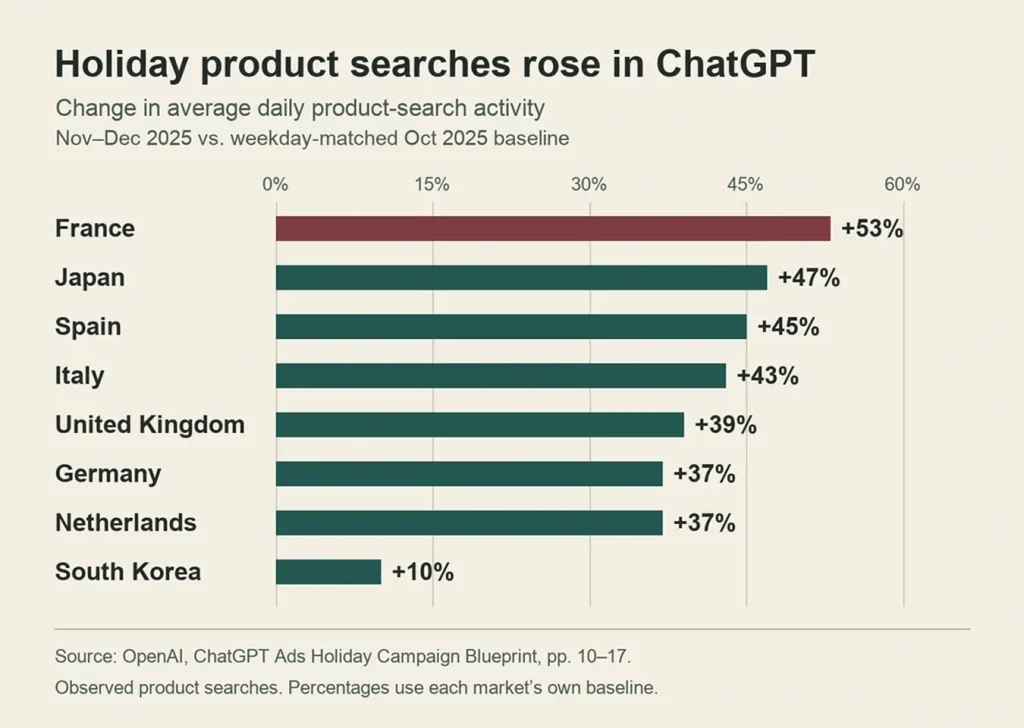
▲ OpenAI’s holiday blueprint. November–December 2025 versus a weekday-matched October baseline.
Give the ad a specific job
ChatGPT Ads can use the conversation’s context, your ad and its landing page to help match a placement. Context hints let you describe situations where a product makes sense, such as “folding commuter bikes for apartments with stairs.” Think of hints as guidance for matching. Placements are labeled as sponsored and appear separately from ChatGPT’s answers. OpenAI’s targeting documentation · How ads appear in ChatGPT
The holiday blueprint shows how to give each stage a different job:
- Awareness. Use a reach campaign and lifestyle imagery, including multi-image ads where available. Show a commuter carrying the folded bike into an apartment. Judge delivery by impressions and cost per thousand impressions.
- Consideration. Use a standard ad to bring shoppers to a guide or comparison. “Which folding e-bike fits your commute?” could lead to a comparison of weight, folded size and range. Watch click-through rate and cost per click.
- Action. Use product-feed ads to feature a curated set of in-stock models and optimize for purchases when eligible. Track purchase volume and cost per acquisition. The blueprint uses impression billing here. In Ads Manager, eligible conversion campaigns can bill by impressions or valid clicks. OpenAI’s campaign setup guide
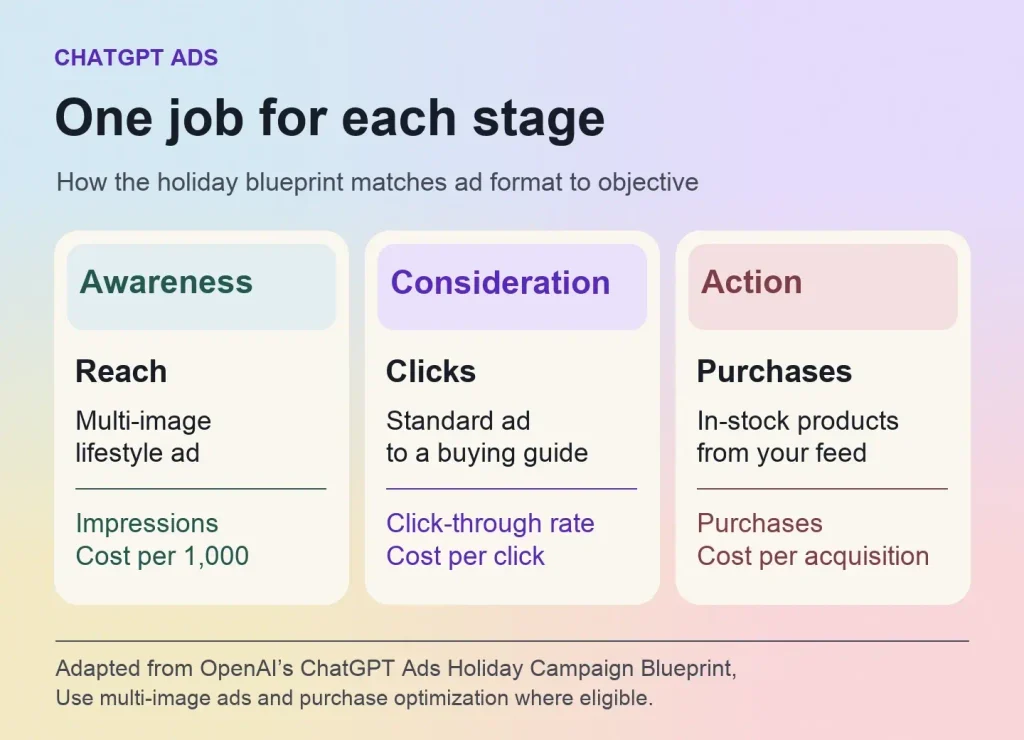
▲ Campaign stages adapted from the ChatGPT Ads Holiday Campaign Blueprint.
The deck’s $500,000 example shows how a large advertiser could fund all three stages. For a first test, we’d start with one market, a small product set and one primary objective. Give the test enough budget to answer a specific question before expanding into a full-funnel plan.
Start with an offer your customers already understand. For the folding bike, test a stair-carry angle against a small-apartment storage angle. Keep the model, market and offer consistent so the comparison tells you something about the message. Before adding a second market, check which campaign options are available in your account and whether your store can fulfil the offer locally.
Four ads we’d test on Shopify
E-bikes for the walk-up commute

▲ Show the shopper what carrying the folded bike looks like.
A shopper asks, “What folding e-bike can I carry upstairs and take on the train?” Try “A folding e-bike for the ride and the stairs.” Use a photo that shows how the folded bike is carried. Send the click to the exact model with the weight (including the battery), folded dimensions and delivery cost easy to find. Show the tested range and its conditions. That’s what the shopper needs to decide whether the bike fits both halves of their commute.
AI hardware that earns a place on the desk

▲ Show how a pocket-sized AI recorder fits naturally into everyday work and client interviews.
A consultant asks, “Is there a small AI recorder that can transcribe client interviews, and what does it cost after I buy it?” Try “Pocket-size meeting recorder with AI transcripts.” Show the device beside a notebook for scale. On Shopify, put supported languages, included transcription minutes, subscription costs and audio storage and deletion options beside a sample transcript. The ongoing cost and data handling can decide this purchase before battery life ever comes up.
Fashion with fewer fit surprises

▲ Show how one versatile sweater takes you effortlessly from the airport to the plane and dinner.
A shopper asks, “What can I wear on a long flight and still look put together when I land?” Try “A merino travel knit you can dress up.” Show the same piece at the airport and at dinner. Land shoppers on the advertised colour, with garment measurements, model sizing, care instructions and holiday exchange dates visible on mobile. Use in-stock sizes for promotions, especially when a high-volume size sells out.
Consumer tech for a noisy flight

▲ Show how wired noise-canceling headphones connect to an airplane’s in-flight entertainment system.
A shopper asks, “Which noise-cancelling headphones under $200 work with a seatback screen?” Try “Noise-cancelling headphones with wired audio.” Link to the advertised model with its current price, wired compatibility, included cables and battery life with noise cancellation enabled.
Two categories we spotted at IFA offer their own angles. For a smart ring, try “A smart ring you can size at home” and show how the sizing kit, shipping and any subscription work. For a compact charger, try “One charger for your laptop and phone” and show how power is divided when both are plugged in. Naturality’s IFA trend report
From crowdfunding to your Shopify launch
A Kickstarter or Indiegogo campaign can show you what persuaded early backers. Use their questions to choose your first Shopify ad angle. If backers kept asking whether your portable power station could keep a mini fridge running at a campsite, that’s an ad worth testing. Show the tested runtime and the fridge’s power draw on the Shopify product page.
Match the campaign to what shoppers can do today. Before retail stock arrives, send interested shoppers to a clearly labelled launch waitlist and measure the cost per signup. Once the product is available to order, link to the Shopify product page and measure the cost per purchase. Keep pricing, shipping dates and availability consistent from the ad through checkout. OpenAI’s ad and landing-page guidance
We helped Litejam make the move from a crowdfunding launch to ongoing Shopify sales through store optimization and paid media. The same transition gives new products a clear starting point for a ChatGPT Ads test. Naturality’s Litejam case study
Get the feed and tracking right before Cyber Week
For eligible stores, the ChatGPT Business app in Shopify can connect the ad account, sync product data and help set up conversion measurement. Shopify’s organic ChatGPT discovery runs through its Agentic Storefronts channel. On the paid side, check the exact variants, prices, currencies, stock and destination URLs that your campaign will use. Review the page on mobile and put specs, compatibility, shipping and returns in readable text. Shopify’s ChatGPT channel guide · OpenAI’s product-feed documentation
Test a purchase before spending. Confirm the order value and currency, apply consistent UTM tags, and check that a browser pixel and server-side Conversions API count a shared purchase once if you use both. Review delivery every two or three days over peak periods and keep an eye on local shipping cutoffs. If clicks look healthy but orders stall, check whether the advertised variant is available and whether the delivery date changes at checkout. After Christmas, test a new use case. A holiday headphone gift guide can become a January travel or work-from-home campaign. OpenAI’s conversion tracking · Holiday best practices
What would make you spend more?
Set your allowable acquisition cost before launch. If a $150 order leaves $45 after product cost, fulfilment, fees, discounts and expected returns, a $45 acquisition cost uses up the entire contribution on that order. If you want to keep $15 per first order, set your target at $30.
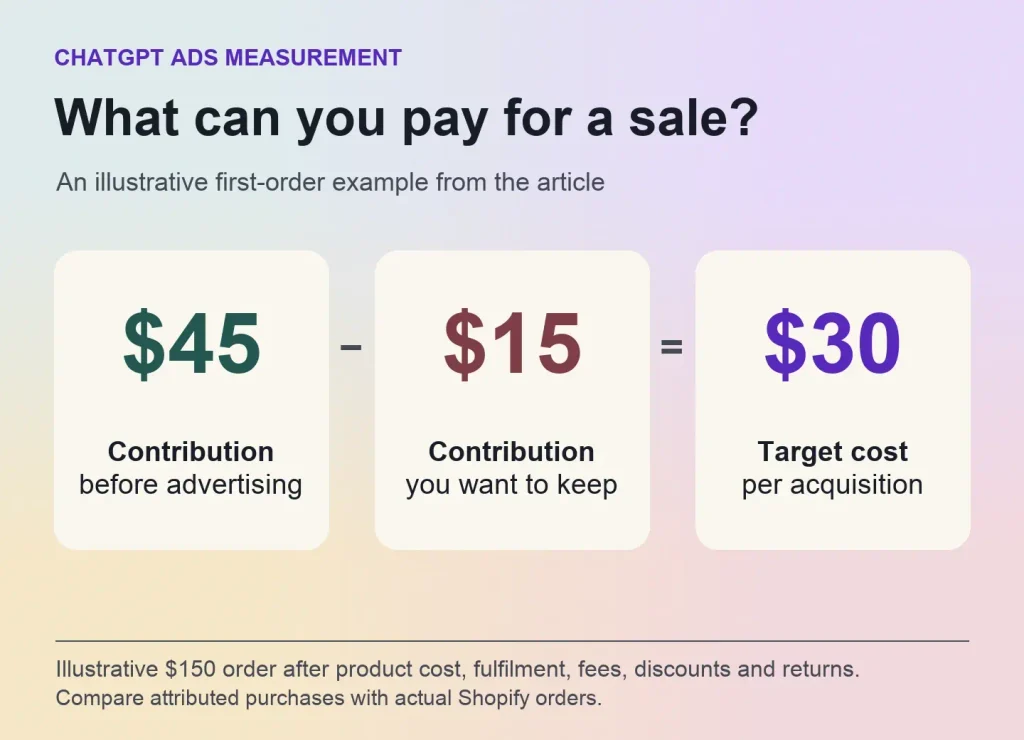
▲ An illustrative target cost per acquisition for a $150 Shopify order.
Check the attribution settings before comparing results. Ads Manager can include eligible view-through conversions in its total when the one-day view-through window is enabled. Read click-through and view-through results alongside actual Shopify sales and new-customer mix. Keep the same reporting windows when comparing campaign variants. If you have enough volume, a holdout can help show whether the campaign generated additional orders. OpenAI’s reporting guide
Looking for ChatGPT Ads management to grow Shopify sales or bring a crowdfunded product to market? Naturality Digital can help you choose what to test, prepare your Shopify store, build the ads and measure what each campaign contributes. Tell us what you sell and where you want to grow. Get in touch with Naturality Digital.