



Imagine you are launching a robotic lawn mower. On Google, someone searches for “best robotic lawn mower.” On Instagram, they discover an impressive video showing a robot navigating a garden. On TikTok, they watch a creator testing whether the machine can handle difficult terrain.
On ChatGPT, the conversation might look very different:
“I have a three-quarter-acre garden with uneven slopes, several trees, and no perimeter wire installed. What kind of robotic mower would work best?”
A few questions later, the customer is comparing navigation systems, maximum slopes, obstacle detection, maintenance, and price. Same product category. Very different purchasing context.
This distinction is at the heart of ChatGPT Ads, OpenAI’s advertising platform built around conversational relevance rather than traditional keyword targeting alone. But before marketers rush to redirect their budgets, there is a more important question: What can ChatGPT Ads do differently from Google, Meta, TikTok, and Pinterest—and when should businesses use it?
1. Advertising has always followed intent. Now intent has more context.
Most successful digital advertising platforms already use sophisticated systems to understand customers. Google knows what people search for. Meta uses engagement, behavioral, and conversion signals. TikTok combines content discovery with search activity. Pinterest connects products with visual inspiration and planning.
ChatGPT offers something additional: customers can describe their needs in natural language, explain constraints, challenge recommendations, and progressively narrow their choices. Consider someone shopping for a mechanical keyboard.
A Google search might begin with “mechanical keyboard under $100.” In ChatGPT, the user could explain: “I’m a programmer working from home. I want a compact mechanical keyboard that feels good for long typing sessions, but I share a room with someone, so it can’t be too noisy. Is a 75% layout enough?”
The latter provides substantially more information about the purchase decision: occupation, working environment, noise sensitivity, preferred form factor, and potential objections.
According to OpenAI’s retail shopping research, more than 1.7 billion retail and e-commerce prompts were generated weekly on ChatGPT in September 2026. Approximately 43% of shopping-related conversations involved comparing or evaluating options. These figures represent conversational activity—not paid advertising impressions, unique users, or confirmed purchase intent.
The opportunity is no longer limited to identifying who may be interested. It is understanding why a product might fit a specific situation.
2. ChatGPT vs. Google, Meta, TikTok and Pinterest: where each platform wins
Before building a campaign, advertisers should understand the role each platform plays. These channels do not simply compete for the same customer at the same moment.
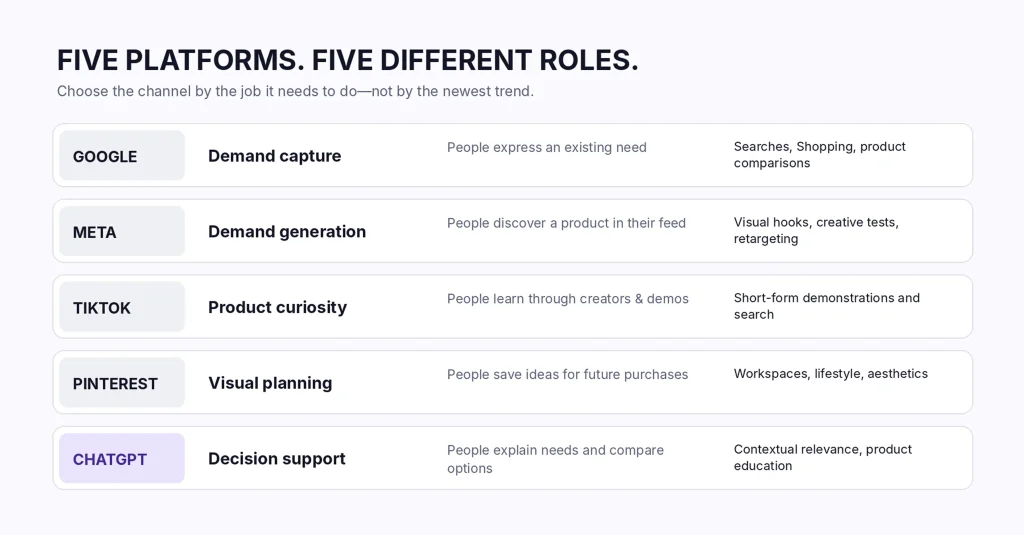
▲ A practical channel-role comparison, designed by Naturality Digital.
Google Ads: capturing demand people already express
Google remains exceptionally effective for reaching people actively searching for specific products and solutions. If someone searches “buy low-profile mechanical keyboard,” Search and Shopping can connect that person with relevant retailers. Google also extends far beyond exact keyword matching: Performance Max and AI-powered Search use contextual signals and machine learning to optimize delivery and creative.
The practical distinction is the environment. Google connects searches with information and shopping destinations; ChatGPT can evaluate a set of needs that develops across an ongoing conversation. Best fit: existing demand, high-intent product searches, and competitor comparisons.
Meta Ads: creating demand through discovery
Facebook and Instagram help innovative hardware brands reach people who were not planning to buy. Consider a compact smart coffee machine: someone scrolling Instagram may not be researching brewing equipment, but a clear video showing automated preparation and thoughtful design can create interest.
Meta’s machine-learning systems optimize delivery and conversion outcomes. The advertiser’s challenge is often to make people care about a product before they search for it. Best fit: audience discovery, creative validation, remarketing, and visually compelling product launches.
TikTok Ads: turning curiosity into product desire
A satisfying mechanical keyboard demonstration, a compact robot solving a surprising task, or a clever hardware prototype can grab attention immediately. TikTok also offers AI-supported Search Ads, so it would be wrong to describe the platform as entertainment alone.
Its strength is the combination of creator credibility, product demonstration, discovery, and search. Best fit: demonstrable innovations, enthusiast communities, and short-form creative built for fast comprehension.
Pinterest Ads: reaching people planning something
Pinterest is more closely associated with visual planning. A person building a board for a minimalist home office might discover premium desktop accessories or keyboards before choosing a product. Pinterest Shopping Ads support this discovery environment. Best fit: visually distinctive technology, workspaces, interiors, and purchases connected with lifestyle projects.
ChatGPT Ads: reaching people working through a decision
ChatGPT can accommodate a longer sequence of questions: understanding an unfamiliar problem, comparing alternatives, checking specifications, and deciding what fits. Its ads system can use conversational context, advertiser information, and other permitted signals to identify relevant sponsored placements.
Crucially, advertisements remain separate from ChatGPT’s answers. Advertisers cannot pay to change the assistant’s independent recommendations, and context hints do not guarantee placement in a particular conversation. OpenAI’s ad principles make this distinction explicit.
3. The biggest change is understanding the buying journey
Marketers have long divided campaigns into awareness, consideration, and conversion. The framework is helpful, but actual buying behavior is rarely orderly. Take a smart coffee machine, a category Naturality knows from its work with xBloom.
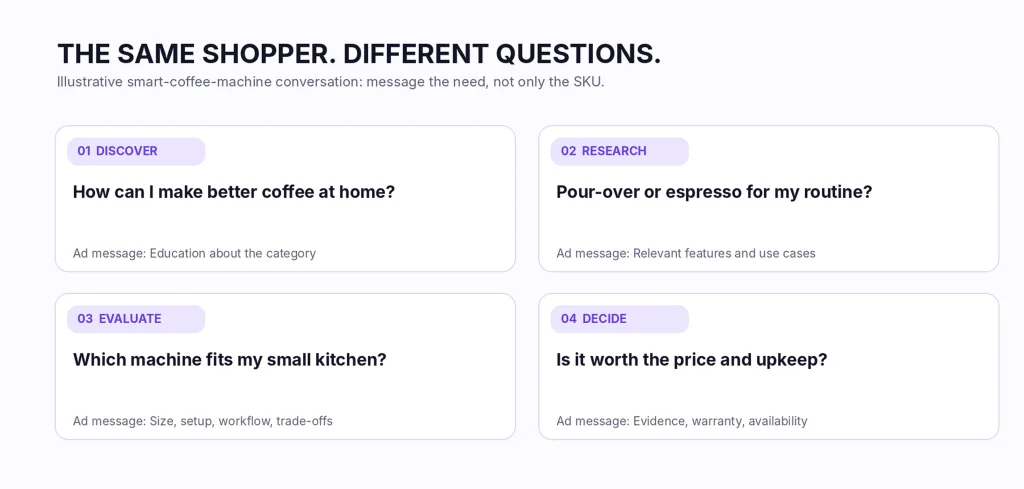
▲ The same buyer can reveal new requirements through successive questions.
The conversation progresses from general curiosity to a clear set of purchase requirements. Different questions expose different levels of commercial readiness. Someone exploring brewing methods needs educational content; someone comparing machines needs meaningful specifications and demonstrations; someone questioning price may want warranty, maintenance, and proof of value.
One generic advertisement cannot communicate all those benefits equally well. Instead, prepare messages at three levels:
- Problem-led: explain the frustration or unmet need your product solves.
- Solution-led: demonstrate why its technology and design fit the need.
- Decision-led: provide the evidence that helps customers compare and commit.
This does not give advertisers control over the exact stage of every conversation. ChatGPT still makes relevance decisions. It gives brands a better way to prepare meaningful messages for the different reasons people buy.
4. What innovative consumer tech brands can learn
New hardware often has a difficult marketing problem: the customer may not know what to search for, or even realize that a solution exists. This is common on Kickstarter and Indiegogo, where brands introduce unfamiliar technology, unusual form factors, and new use cases.
Robotics: sell the solved problem, not just the engineering
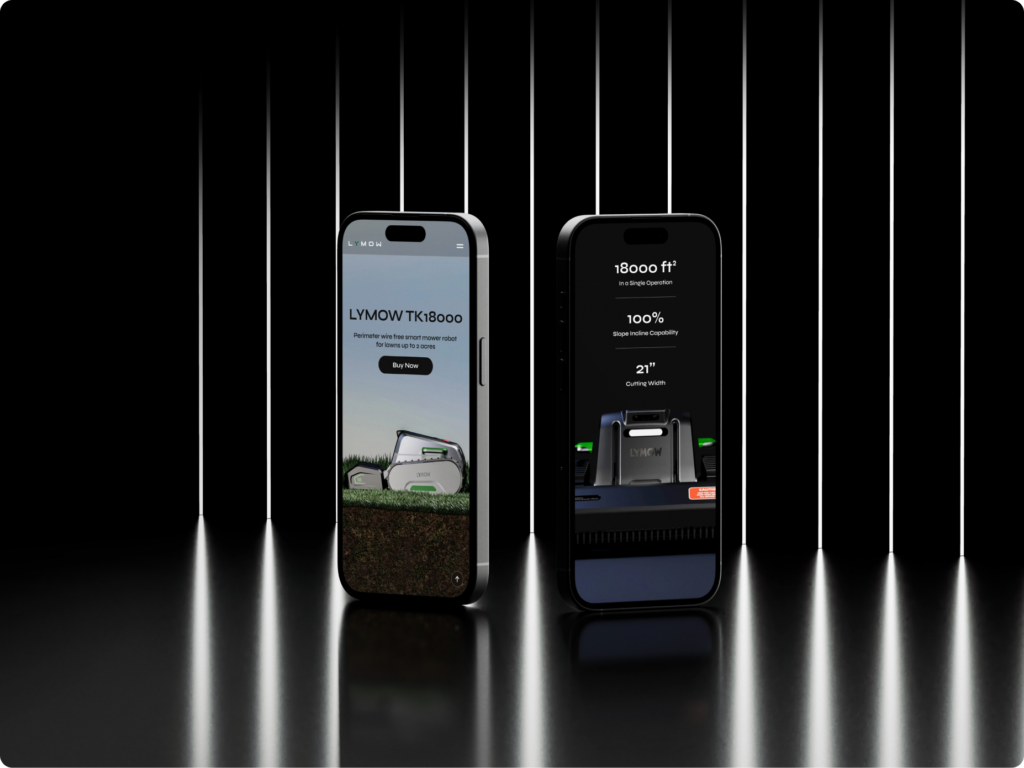
Robotic lawn mowers can be advertised with navigation systems, sensors, and slope ratings. Those specifications matter, but a homeowner primarily wants to know whether a mower handles their yard reliably, navigates obstacles, and reduces maintenance time.
Naturality’s work on the Lymow One product presentation focused on making advanced functionality easier to understand through coherent product storytelling. A conversational advertising message about managing complex terrain may be more useful than a broad “most advanced robot” claim—provided the product truly supports the use case.
Mechanical keyboards: one product, different motivations

A gamer might prioritize latency and response. A programmer may value comfort, layout, and switch feel. Someone sharing a home office may care primarily about noise. Those buyers are not defined by a single demographic label.
Naturality’s MCHOSE GX87 launch illustrates why a hardware product should not be positioned for one community without testing other plausible needs. Contextual messaging becomes more effective when it is grounded in real product suitability rather than broad audience stereotypes.
STEM robotics: parents buy outcomes, not components
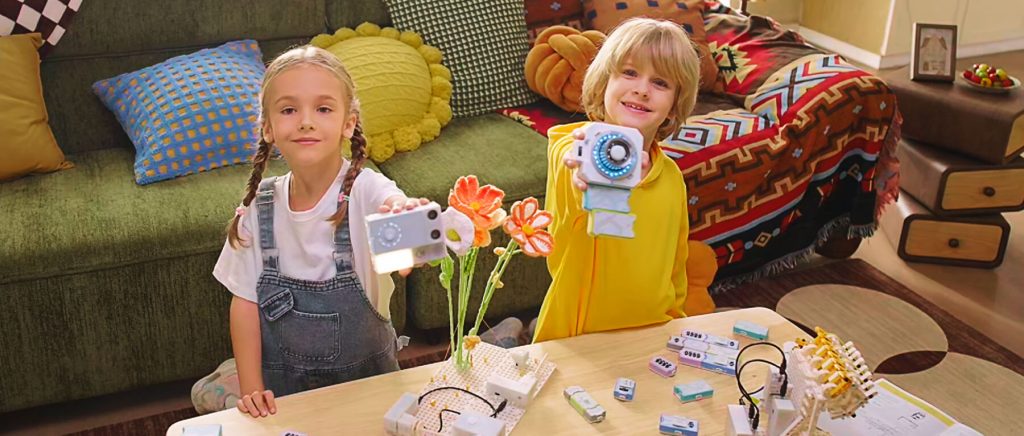
Parents considering educational robotics might ask how to encourage screen-free learning, introduce coding, or support hands-on exploration. That is a different starting point from typing “coding robot” into a search bar.
For CodeeBot, Naturality’s crowdfunding strategy addressed robotics, accessible programming, family engagement, and creative experimentation. The general lesson is that the same hardware can serve distinct motivations—and those motivations should shape the creative.
Connected musical instruments: education can beat a promotion

Connected instruments and music-production devices can require substantial explanation. A beginner might want to make music without a complicated studio. An experienced musician might be worried about integration with existing equipment.
Our work with PopuMusic PartyStudio showed how positioning must connect technical functionality with audience understanding. ChatGPT conversations may surface skill level and workflow constraints before the shopper considers a specific product. Better context can help, but it never replaces genuine product fit.
5. Context hints: what advertisers should understand
One distinctive ChatGPT Ads feature is the context hint: a natural-language description of situations where an advertisement may be relevant. OpenAI’s context-hint guidance encourages advertisers to describe what a product offers, who it helps, and when it is useful.
For a robotic mower: “Robotic mowing solutions for complex residential gardens.” For a keyboard: “Quiet mechanical keyboards for shared home offices.” For education hardware: “Hands-on coding activities for children learning robotics.”
These are examples, not guaranteed targeting phrases. Context hints are signals to the relevance system, not exact-match keywords, exclusions, or instructions that force a placement. An advertiser should build them from customer evidence: interviews, surveys, FAQs, product reviews, comparisons, and objections.
The technology may be new, but the principle is familiar: understanding customers produces better advertising.
6. Should you shift budget from Google or Meta to ChatGPT?
Not automatically. Treating every emerging platform as an immediate replacement is a costly mistake. For a hardware launch, Meta or TikTok might introduce the product, creator reviews and YouTube can build credibility, Google can capture branded or category searches, and ChatGPT Ads can add reach during research and evaluation.
The allocation should reflect how well known your product category is, how complicated the buying decision is, what creative assets you have, and whether incremental sales can be measured. Start with four questions:
- Does the customer already know what to look for? If so, demand capture may deserve more investment; unfamiliar products often need education first.
- Does the purchase require technical research? Compatibility, specifications, and comparisons can make conversational discovery relevant.
- Can a demonstration communicate the benefit immediately? Visual-first channels may be especially useful when the product explains itself on video.
- Can you measure profitable incremental growth? Examine cost per acquisition, contribution margin, new customers, and attribution limits—not just clicks.
For most businesses, the rational first move is a controlled ChatGPT Ads experiment alongside proven acquisition channels, rather than a large, untested budget transfer.
7. What early ChatGPT advertisers are seeing
Early case studies provide encouraging signals, but they are not universal benchmarks. Retailer Newegg used product-feed advertising and seasonal promotions to reach customers researching PC components. OpenAI reported approximately 3× attributed ROAS across campaigns and 7× during a two-week Fantastech Sale campaign.
In a separate example, VistaPrint used conversational advertising to reach small-business buyers exploring products for launches and projects. OpenAI reported 5.9× ROAS in a U.S. product-category conversion campaign. The outcome is advertiser-specific and should not be treated as a promise for another brand.
These examples suggest two useful principles: the channel can be relevant during both product research and buying decisions, and execution—including message quality, campaign objectives, and measurement—matters as much as access to new inventory. Attributed outcomes should not be mistaken for controlled proof of incrementality.
8. What this means for the next generation of product launches
Crowdfunding and DTC hardware launches often follow a familiar rhythm: create a product video, build a landing page, run Meta tests, collect leads, and scale promotion around launch. That workflow remains valuable. Conversational discovery adds another dimension.
A potential customer may not know the name of your technology, follow relevant influencers, or search for the right product category. Yet they may be able to articulate exactly the problem your device solves. That shifts campaign planning away from “Which audience should we target?” alone and toward “Which real decisions make our product useful?”
For startups and established technology brands alike, this increases the value of clear positioning, honest specifications, credible evidence, and genuinely helpful product education. An innovative device with vague benefits or overstated claims will not become persuasive merely because the ad system is powered by AI.
The takeaway: do not replace your strategy. Make it smarter.
ChatGPT Ads is a meaningful development in digital advertising—not because it renders Google, Meta, TikTok, or Pinterest obsolete, but because it introduces another environment for reaching customers while they clarify and evaluate needs.
For innovative consumer technology brands, the opportunity is to combine discovery, demand capture, product education, and conversational relevance into a more complete acquisition strategy. The strongest campaigns will be grounded in product truth, differentiated creative, sound measurement, and disciplined media buying.
At Naturality Digital, we help technology and consumer hardware brands build international growth strategies—from crowdfunding launches and creative production to performance advertising and e-commerce expansion. Our cross-channel experience helps determine where emerging opportunities such as ChatGPT Ads genuinely belong in the wider marketing mix.
Planning to advertise on ChatGPT—or deciding how to integrate it with your existing campaigns?
You do not need another advertising account without a strategy behind it. You need clear positioning, strong creative, reliable measurement, and experienced media buyers who can turn marketing investment into business growth. Contact Naturality Digital to explore your next campaign.